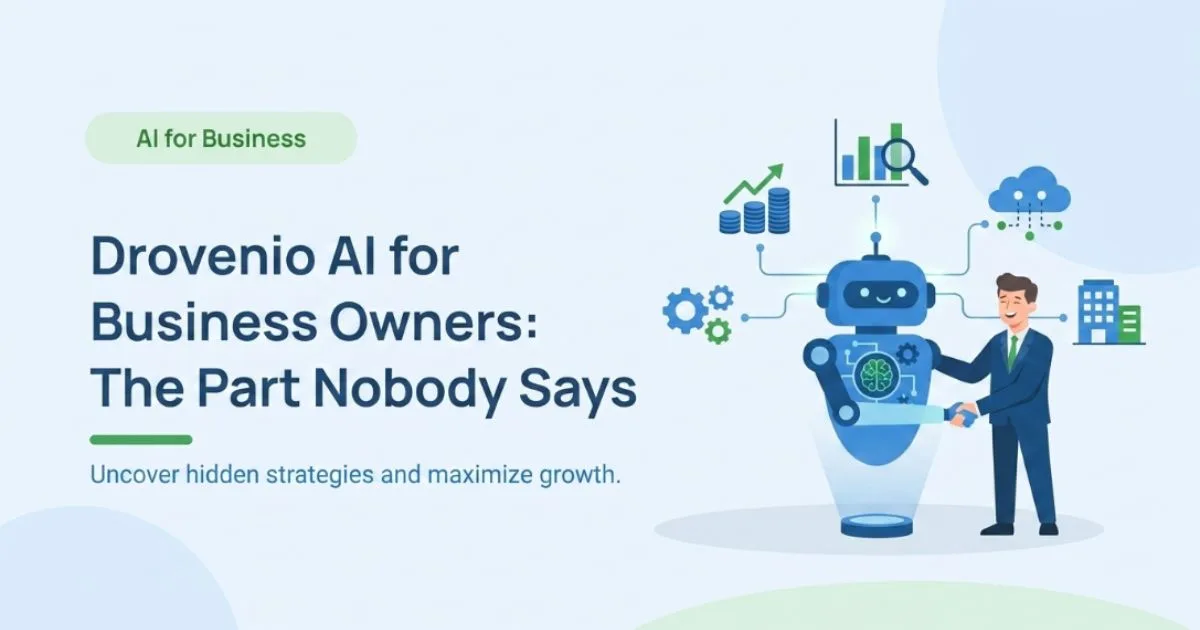
Drovenio AI for Business Owners: The Part Nobody Says
You don’t need another shiny AI tool promising to “revolutionize” your business while quietly turning your afternoon into a mess of tabs, logins, and half-finished experiments. You need something that saves time, reduces guesswork, and doesn’t make you feel like you’re enrolled in a second job.
That is the real reason people start looking at Drovenio AI in the first place. Not because they are chasing hype. Because they are trying to make business feel a little less like juggling knives while reading invoices.
For business owners, especially beginners, the hard part is not finding AI. It is figuring out what kind of AI is worth touching at all. Drovenio AI sits in that awkward space between “helpful” and “one more thing to learn,” which is exactly why this guide matters. Droven.io is described as an editorial AI and automation knowledge platform focused on helping business owners, operators, and learners understand AI before they buy into it, while other pages also describe Drovenio AI tools with content writing, SEO, chat, and automation features. That distinction matters, because a lot of confusion starts there.

The Thing Nobody Actually Says Out Loud
The biggest mistake people make with AI tools is assuming the tool is the strategy. It is not. It is a shortcut, or sometimes just a faster way to do the wrong thing, which is very on-brand for modern software.
If you are a business owner, the first question is never “What can this AI do?” It is “What is stealing my time every week?” That might be customer replies, blog drafts, product descriptions, meeting summaries, or the endless small tasks that eat the day before lunch. AI makes sense when it cuts one of those repeating jobs down to size. That is the whole game.
Drovenio AI is useful in that exact zone because it is commonly framed around content, SEO, chat assistance, and workflow support, not just one narrow feature. That makes it more interesting than the usual one-trick tool, but also a little more slippery. Multi-purpose tools look impressive in demos. In real life, they only matter if they fit your actual bottleneck.
If your business problem is fuzzy, AI will happily give you faster fuzzy output.
That is the part nobody wants to admit. Students love AI because it feels powerful. Founders love it because it sounds efficient. But if you are not clear on the task, you just get polished confusion. It is the same energy as buying a gym membership to “get serious” and then using the treadmill once.
There is also a deeper issue here: trust. Business owners do not just want output. They want output they can explain to a client, a professor, a customer, or their own future self. AI-generated work that sounds good but cannot be defended is useless. That is why the smarter way to use Drovenio AI is not “let it do everything.” It is “let it handle the boring first draft while you keep judgment in the loop.”
That sounds simple. It rarely is. The first time you try it, you realize the tool is not replacing thinking. It is exposing how much of your week was already spent on repetitive, low-value work.
How This Actually Works The Real Mechanics
Drovenio AI makes more sense when you look at it as a business support layer, not a magic box. AI platforms in this category typically help with drafting, summarizing, organizing, and automating repetitive content or workflow tasks, while broader business AI adoption is increasingly tied to strategy, operations, and repeatable scale, not just novelty. That is the real mechanics part people skip because it is less exciting than “instant results.”
Here is the practical way to think about it: you give the tool a task, a context, and a standard. If any one of those is missing, the output drops fast. That is why people who say “AI didn’t work for me” are often describing bad setup, not bad software. Same tool. Different inputs. Very different day.
A niche detail most generic articles ignore: business owners do not fail with AI because they lack ideas. They fail because they don’t have a clean process to plug AI into. If your workflow is already messy, Drovenio AI will not rescue it. It will just make the mess prettier.
What usually works best:
- Content drafting for product pages, blogs, and email sequences, because first drafts are where most people lose time and energy. The opinion here is simple: let AI do the ugly start, not the final voice.
- SEO support, because keyword clusters, outlines, and meta drafts are tedious but structured. This is one of the rare places where AI’s speed is genuinely useful.
- Customer reply templates, because business communication repeats itself more than anyone likes to admit. The catch is tone; a template that sounds cold can cost you trust.
- Internal summaries, because meetings create work out of thin air and somebody has to clean up the fog.
- Workflow automation, because moving information from one place to another is not a business strategy but somehow eats one anyway.
- Idea generation, which is useful only if you already know how to judge ideas. Otherwise it becomes a very efficient way to collect nonsense.
The specific corner most people miss is this: the value is not in “using AI.” The value is in reducing context switching. That is what burns students and small business owners the fastest. You answer a message, draft a post, check analytics, then return to the original task with half your brain missing. AI helps most when it removes one of those hops.
And yes, there is a learning curve. A small one, then a sneaky larger one. The first week feels easy. The second week is where you discover whether you actually built a workflow or just played with a tool.
Comparison What’s Actually Different
| Option | What it actually does | Who it’s for | The catch |
| Drovenio AI content tools | Drafts content, SEO copy, emails, and business text quickly | Students, solo founders, small teams | Good outputs still need human editing |
| Drovenio AI knowledge platform | Explains AI, automation, and adoption before you buy tools | Business owners who want clarity first | It informs decisions more than it executes them |
| General AI writing tools | Produces fast text across broad use cases | Anyone who needs volume | Usually generic unless you give strong direction |
If you want guidance before commitment, the knowledge-platform angle is more useful. If you want actual output, the content-tool angle matters more. My take: start with the explanation layer if you are unsure, then move to execution only after you know where AI fits in your business.

What Actually Happens When You Try This
The first surprise is usually how ordinary it feels. You expect a dramatic shift, and instead you get a cleaner draft, a faster outline, or a less painful task. That is not sexy, but it is real.
The second surprise is that your own process becomes visible. When you ask Drovenio AI for a blog outline, for example, you notice whether your original idea was too broad, too vague, or just badly structured. Most people blame the tool when the prompt was the problem. That is annoying, but also useful.
What nobody warns you about is the editing tax. AI saves time on the first 60 to 80 percent of a task, then hands you the part that actually matters: accuracy, tone, and fit. That is why businesses that treat AI as a replacement usually end up disappointed, while businesses that treat it as a draft engine get real value.
There is also a pattern that other articles skip because it is less glamorous: people use AI more consistently when the job is repetitive and slightly boring. A student can use it for research notes, content structure, and summary cleanup. A business owner can use it for emails, product pages, and internal documents. Nobody is using it joyfully at first. They are using it because the alternative is another hour of copy-paste misery.
A real example: if you are running a small online store, you might use Drovenio AI to draft ten product descriptions, then rewrite the ones that matter most for tone and accuracy. That is a much better use than asking it to “write my business.” AI is not a CEO. Thank you.
The Advice Everyone Gives vs What Actually Works
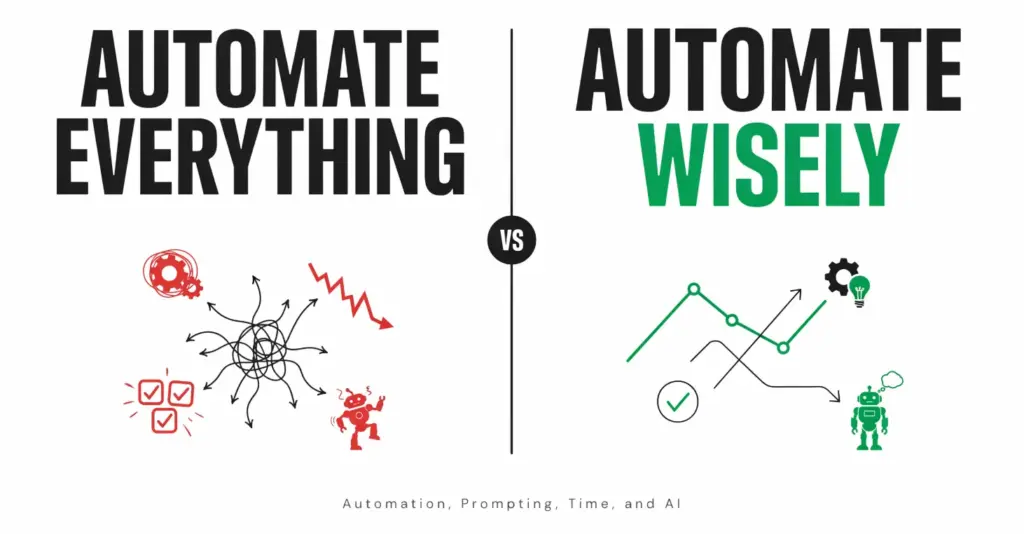
One common piece of advice is “automate everything.” That sounds efficient and usually turns into chaos. Automation is great for repetitive, low-risk work, but terrible when human judgment matters. The realistic alternative is to automate only the parts you would gladly never do again.
Another favorite is “just prompt better.” That is incomplete. Better prompting helps, but the bigger issue is defining the task itself. If your process is unclear, a clever prompt just creates a more polished version of confusion. The grounded fix is to create a repeatable template: goal, audience, tone, length, and one example.
People also say “use AI to save time.” True, but too vague to be useful. Time saved only matters if it gets reinvested into something better, like sales, product quality, or studying. Otherwise you just become faster at being busy. My opinion: measure what AI frees up, not just what it produces.
You will also hear “AI can replace your first draft entirely.” Sometimes, sure. For internal notes or rough ideation, fine. For anything customer-facing, that advice is lazy. The better approach is to let AI start the draft, then make a person responsible for the final version. That is slower than the hype says, and much better than the hype ever is.
The Practical Part What To Actually Do
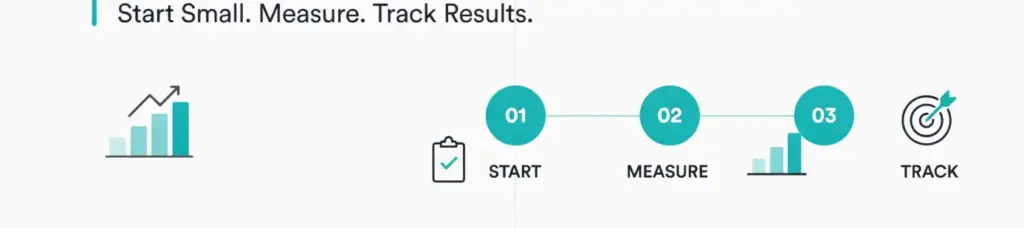
Start with one task you repeat every week. Do not pick the biggest one because that is how people get overwhelmed. Pick something small, annoying, and measurable, like product descriptions, email replies, or social post drafts. If the tool saves even 20 minutes there, you have a real baseline.
Write a simple prompt template before you test anything. Include the goal, audience, tone, and exact output format. A good AI workflow usually looks boring on paper, which is another reason people ignore it. Boring is often where the results live.
Create a before-and-after sample. Save one manual version of the task, then compare it with the AI version after editing. This gives you a real sense of quality instead of the usual “it felt decent” logic that wastes money.
Use the tool on repetitive content first, not sensitive content. That means drafts, summaries, outlines, and template replies before anything customer-critical. The reason is simple: low-risk tasks teach you the system without putting your reputation in the room.
Set a rule for editing time. If the AI draft takes longer to fix than to write from scratch, the workflow is broken. That is not failure; it is a sign you need a narrower task or clearer instructions.
Track one business outcome, not five. Maybe it is time saved, maybe it is more output, maybe it is faster launch speed. People love vague AI wins because they sound impressive. Numbers, even small ones, keep everyone honest.
Questions People Actually Ask
Drovenio AI is generally positioned around AI content, SEO support, chat assistance, and workflow help. Depending on which side of the platform you are looking at, it can also be framed as an AI education and decision-support resource. The practical use is helping business owners produce or understand work faster, not replacing judgment.
Yes, if the business has repetitive work that eats time. Small teams usually get the most value from drafting, summarizing, and structured content tasks because they don’t have spare hours lying around. The catch is that the tool only helps if someone is still responsible for the final result.
It can help draft blog posts and outlines, based on how it is described in current coverage. That said, the best use is usually first drafts and structure, not untouched publishing. Human editing still matters for accuracy, voice, and anything that sounds too generic.
It appears beginner friendly in the sense that the basic tasks are easy to try, especially for content and business support use cases. The harder part is not the interface; it is deciding what to ask it to do. Beginners who start small usually get better results than people who try to automate everything on day one.
Start with one repetitive task and measure the time difference. Pick something low risk, such as a draft email, FAQ entry, or product description. Then compare the AI version against your manual version and decide whether it actually saves effort.
No, not in any serious business setting. It can reduce the amount of raw drafting, but humans still need to shape voice, verify facts, and decide what actually belongs. The tool is a helper, not a substitute for editorial judgment.
It can support automating content creation, basic communication, summaries, and some workflow steps. The important part is that automation works best on repeated tasks with clear rules. If the task needs taste or strategy, keep a human in the loop.
Public coverage mentions paid tools and plans in this space, but pricing details vary by product and source. The safer assumption is that cost depends on the feature set and use case. Before buying, check whether you need content generation, knowledge support, or both, because paying for the wrong layer is just a quieter form of waste.
For AI tech students, yes, if you use it to speed up research notes, outlines, and learning workflows. It is less useful if you expect it to do the thinking for you, which would be a bold academic strategy. Students usually get the best return when they use AI to organize ideas rather than produce final answers.
So Where Does This Leave You?
Drovenio AI is not interesting because it is magical. It is interesting because it sits right where most people actually struggle: between knowing what needs to be done and having the time to do it. That is a very ordinary problem, which is why it matters.
The smartest move is not to commit to everything at once. Pick one task, test it, edit hard, and see whether the tool saves you time without making the output worse. That one experiment will tell you more than ten polished review posts ever will.
The truth is a little dull, which is probably why it is useful: AI helps most when the work is repetitive, the process is clear, and the human is still paying attention. Amazing. Annoying. Accurate.
Conclusion
You made it this far, which means you are either seriously considering Drovenio AI or you enjoy reading people take a perfectly usable tool and inspect it under a dim light. Respect either way.
The main thing to remember is this: AI tools do not fix bad thinking, but they can make good systems faster. That is the honest version, and it is usually enough. Start with one boring task, measure the difference, and stop expecting software to have a personality.