

How to Start Making Money With AI Even If You Have Zero Tech Skills (2026)
You typed something like “how to make money with AI with zero tech skills” because you keep seeing AI success stories, but you can’t code and don’t want to pretend you’re a data scientist. You’re in the right place this guide is built for people who are smart and curious, but not “tech experts.” By the end, you’ll know exactly which no‑coding AI income paths are real in 2026, how much they can pay, and the exact first steps to take.
The confusing part is that most content mixes two completely different worlds: advanced AI engineering and simple AI‑assisted work that anyone can do with clear instructions. You only need the second one. I’ll show you how regular people are using AI tools to create content, support businesses, and sell simple digital products — without writing a single line of code.
This website exists to help 18-25-year-old students and young professionals use AI and digital tools to build practical, realistic income streams. You’ll see real examples, starter workflows, and earning ranges pulled from public data and case studies, all tuned to what’s working in the US and Canada in 2026. The best part is that you don’t need a tech degree or a big budget — just a laptop, a stable internet connection, and a willingness to follow a simple process for at least 30–60 days.
What “Making Money With AI With Zero Tech Skills” Really Means And Why It Matters Now
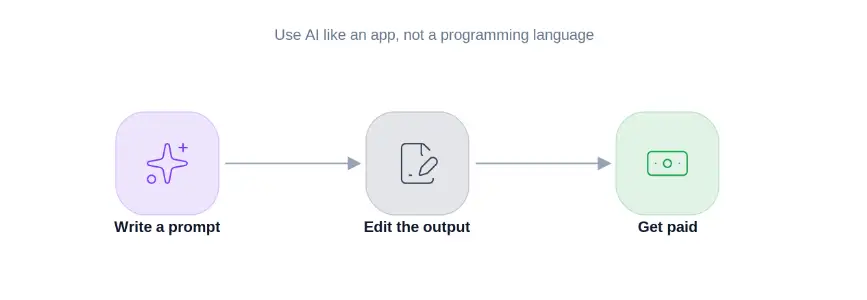
Making money with AI with zero tech skills means using beginner-friendly AI tools to speed up or improve work that people already pay for: writing, social media, simple designs, basic research, and small automations. You are not building AI models or writing code; you’re clicking buttons and writing prompts in tools that hide the complex stuff for you. In practice, it feels more like using Canva or Google Docs than “programming.”
This matters right now because AI is changing entry-level work faster than almost anything else. Reports show that AI is automating parts of content creation, customer support, and marketing, but also creating entirely new roles where non-technical people manage AI tools, edit AI output, or package AI-generated content into products. For students and young adults, that means you can either wait for your future job to be reshaped by AI, or you can start learning how to drive the tools today and get paid for it.
One side hustle statistics report in the US found that the average side hustle income in 2025 was $885/month, while the median was $200/month — a small group earns a lot, but many people earn smaller amounts. From what I’ve seen in AI‑related side hustles, this pattern is similar: a few people turn their AI work into serious businesses, while many others earn a helpful “second phone bill” amount. The difference usually comes from who treats it like a real, improving skill instead of a weekend experiment.
Most “no tech skills” guides stay vague or skip the part where you have to talk to clients, set up profiles, or package your offer. Here, you’ll see a clear process you can follow even if your only current tech skills are typing and scrolling. We’ll start with three of the easiest no‑code paths, then I’ll show you a simple decision tree so you can match one to your personality — and later, we’ll talk about the exact numbers you can realistically aim for in your first 90 days.
Who This Is For and Who Should Skip It
This guide is for students, part-time workers, and early-career people who consider themselves “not technical” but can handle basic apps, websites, and social platforms. If you can use Instagram, copy-paste text, and upload a file, you have enough skill to start with the methods here. You’ll benefit most if you are between 18 and 25, have 1–3 hours most days, and want a way to earn from your laptop without pretending to be a programmer.
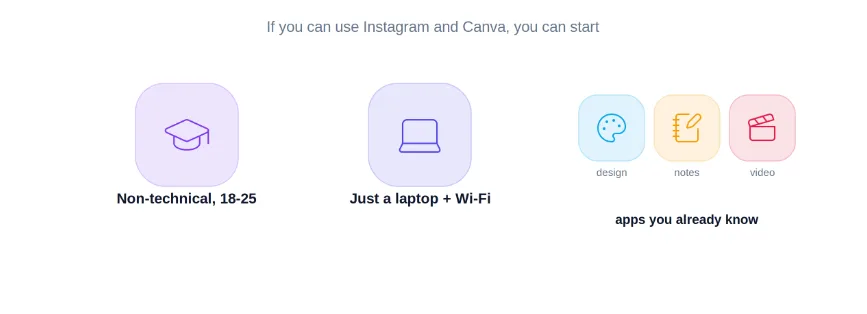
You’ll get strong value from this article if:
- You are comfortable learning new apps by clicking around. Maybe you’ve tried Canva, Notion, or TikTok editing already — that same mindset works great for AI tools.
- You are okay with writing short messages or scripts. Many AI income paths here involve simple writing: social captions, YouTube scripts, emails, or product descriptions.
- You prefer clear, repeatable steps over “startup ideas.” These methods are closer to side jobs than big companies; you don’t need a brand new idea, just a useful service or product.
You should skip this (for now) if:
- You refuse to communicate with people. Selling on marketplaces or finding clients requires basic messaging and replies; this is hard to avoid if you want more than a few dollars.
- You are only interested in 100% passive income immediately. Most realistic AI side hustles start as active work that becomes more passive as you build templates, products, or channels.
- You want guaranteed numbers. Side hustle data shows a wide range — some earn a lot, many earn a little — and your results depend on effort, niche, and how quickly you learn.
The most important, often misunderstood requirement is that you must be willing to learn one specific AI‑assisted skill and stick with it for at least 30 days before judging it. If you are a curious, non-technical 18–25-year-old who wants a realistic way to turn AI tools into actual money, this article is written for you.
How It Actually Works Complete Process
When you actually try to make money with AI with zero tech skills, you realize it’s not about having “the perfect tool.” It’s about following a simple, repeatable process: pick one no-code path, learn the tool basics, create proof, and then put your offer in front of real humans until something sticks. Most guides rush past this and jump straight to “top 10 side hustles,” which is why so many people get stuck.
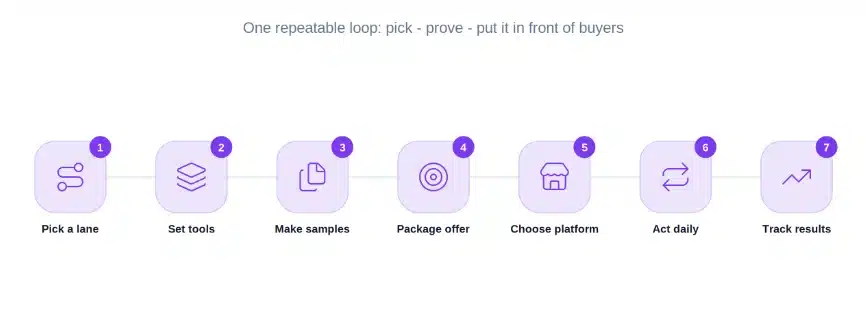
Step 1: Pick one no‑code AI lane that matches you.
Start by choosing from 3–4 beginner-friendly options: AI-assisted content writing, social media support, simple AI designs, or AI-aided digital products. Ask yourself two questions: do I like words, visuals, or organizing information; and do I prefer working for clients or selling my own products? Your answers narrow the list to one clear starting path.
Step 2: Set up your minimum tool stack (in one afternoon).
For almost every non‑technical AI side hustle, you’ll use one main AI tool plus 1–2 helper tools. For example: ChatGPT + Google Docs for writing, or Canva + a built‑in AI design feature for graphics, or a simple print‑on‑demand site plus an AI art generator for merch designs. Create free accounts, complete the onboarding tutorials each tool offers, and save 1–2 starter prompts or templates that you understand. Avoid installing 10 apps “just in case.”
Step 3: Create 2–3 sample projects before looking for money.
This is a step most beginners skip. Take your chosen lane and create examples of the work you want to get paid for: three short blog posts, five Instagram posts, one mini product (like a simple planner or digital checklist), or a small batch of T‑shirt designs. You can base these on real businesses you like or made-up brands. The goal is to prove to yourself — and later to clients — that you can guide AI into something good and usable.
Step 4: Package what you do into a simple, clear offer.
Don’t just say “I use AI to help.” Instead, write one or two sentences that describe your outcome, timeline, and starting price. For example: “I’ll create 10 AI‑assisted TikTok captions for your next product launch in 3 days,” or “I’ll design five AI‑generated T‑shirt designs ready for print‑on‑demand stores.” Add your best sample pieces below this offer so people can see what they are buying.
Step 5: Choose one place where people will see your offer.
You can start on freelance platforms (Fiverr, Upwork), marketplaces (Etsy, Gumroad, print‑on‑demand sites), or social/DM‑based outreach (LinkedIn, Instagram, local Facebook groups). Pick just one or two channels to start. The biggest mistake is scattering your attention everywhere; focused effort on one platform for a month beats weak effort on five platforms.
Step 6: Do small, daily actions that put you in front of buyers.
For services, this means sending proposals or DMs; for products, it means publishing listings, posting content that points to your shop, or improving your product descriptions. Aim for a daily quota like “3 proposals per day” or “1 new product listing + 1 social post per day.” When you actually do this, you’ll find that the work feels repetitive, but that’s exactly how side hustles grow.
Step 7: Watch what works once you get your first response.
The moment someone replies, orders, or comments, you’ve got data. Pay attention to which offers get replies, which designs sell, which posts drive traffic. Then improve your offer, samples, or product around those signals instead of constantly switching to the next “AI hack” video.
The thing most guides get wrong is pretending that AI removes the boring part of building income. It doesn’t. What AI removes is a chunk of production time; you still have to decide what to make, who to serve, how to talk to them, and how to improve. Once you accept that, the whole process becomes much less scary and much more predictable.
Comparison Table No Tech AI Income Options Side by Side
| Name / Option | Key Feature | Best For | Limitation | Verdict |
| AI‑assisted content writing & social posts | AI drafts, you edit and format | People who enjoy writing and simple research | Competitive; low pay if you don’t edit well | Easiest starting path, great for first $100–$300/month |
| AI designs for print‑on‑demand | AI creates art, POD sites handle printing & shipping | Visual thinkers, T‑shirt or merch fans | Needs multiple designs and some marketing to see sales | Good semi-passive option once you build a catalog |
| Faceless YouTube with AI scripts & visuals | AI helps with scripts, visuals, and sometimes voice | Patient creators who like storytelling | Slow to grow, relies on YouTube algorithm and consistency | Strong long‑term asset if you can post regularly |
| AI‑powered digital products (templates etc.) | Use AI to build planners, prompt packs, mini guides | Organized people who like systems and checklists | Takes time to get first sales; needs SEO or audience | Great way to turn one‑time work into repeated sales |
| AI research & simple data tasks | Use AI to summarize, compare, or clean basic information | Detail-oriented people who don’t mind “boring” work | Often priced lower; you must be careful with accuracy | Underrated starter for VA‑style roles, then upskill |
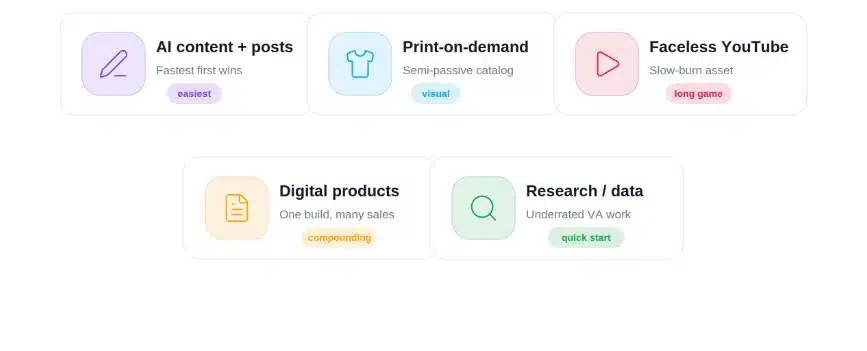
If you like words and quick wins, AI‑assisted content and social posts are usually the fastest way to get your first small payments. If you prefer visuals and want income that can compound over time, print‑on‑demand designs, faceless YouTube, and digital products are better medium‑term plays.
Real Benefits With Numbers and Specifics
When you do this in a focused way, the main benefit is turning your basic internet habits into paying skills. Many guides on AI side hustles show beginners earning anywhere from $50 to a few hundred dollars per month in their first months, with some scaling up to $1,000+ as they refine their offers and build systems. That range lines up with broader side hustle data in the US, where the median side hustle earner sits around $200 per month — a realistic starting point.
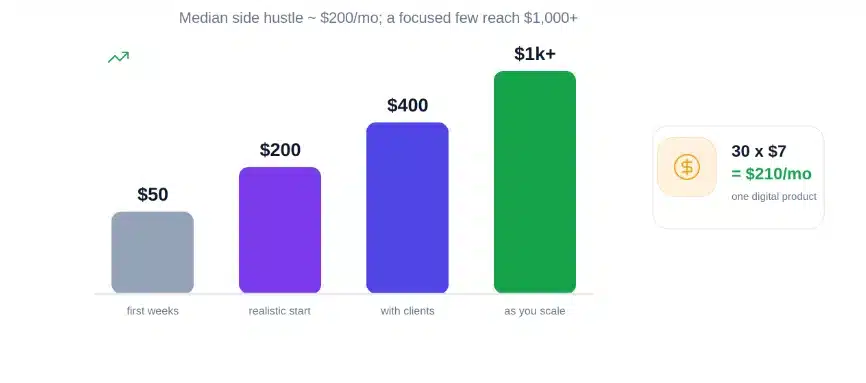
Say you pick AI‑assisted content writing and charge $25 per blog‑style article to start. If you can deliver two articles per week, that’s $200/month; At four articles per week, you are at $400/month. AI doesn’t magically double your rate, but it can cut your writing time in half, which means you can handle more assignments without feeling overwhelmed. In practice, you’ll notice that one evening of focused work now covers what used to take you an entire weekend.
On the product side, students creating AI‑helped planners, prompt packs, or simple mini‑courses often see slow but steady sales once they have 10–30 listings, especially on marketplaces like Etsy or Gumroad. One well‑positioned digital product selling just 30 copies a month at $7 brings in $210 — not life‑changing, but meaningful when stacked with service income. And because the product is digital, that same asset can keep selling while you focus on new projects.
A benefit most articles leave out is confidence. When you start from “zero tech skills” and successfully guide an AI tool to create something a stranger pays for, your view of what you can learn changes. In practice this means that future tools, apps, or even basic coding feel less scary, because you have already proven to yourself that you can handle new tech and turn it into income. That mindset shift often matters more than the first $100 you earn.
Beginner Mistakes Most People Make and the Fix
Mistake 1: Believing “no tech skills” means “no learning.”
People are drawn to headlines promising money with “no skills,” then get frustrated when they hit even a small learning curve in a new tool. The human part here is wanting results without the uncomfortable beginner phase. Fix it by expecting the first 7–10 days to feel messy and slow; once your brain builds a mental model of how your chosen tool behaves, everything speeds up.
Mistake 2: Copying AI output directly into products or client work.
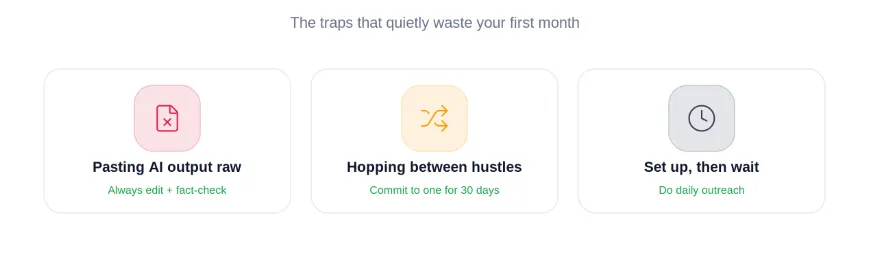
Many beginners paste a prompt, accept the first AI result, and upload or send it without editing. This happens because the output looks polished at first glance, so it’s tempting to trust it blindly. The consequence is weak content, factual mistakes, or designs that look generic. The fix is to treat AI as a rough draft: always add your own examples, adjust tone, and double‑check facts or spelling before publishing.
Mistake 3: Jumping between five different side hustles in two weeks.
You watch one video about AI writing, one about YouTube automation, one about print‑on‑demand — and try all of them for one or two days. The result is no portfolio, no listings, and no clients. Commit to one path for at least 30 days; that gives you enough time to build samples, publish offers, and get feedback you can actually learn from.
Mistake 4: Setting up profiles and then waiting passively.
This is the mistake a lot of students are making right now without realizing it. They create a Fiverr or Upwork profile, maybe list one product, then check back each week hoping magic orders appear. Freelance marketplaces and digital product platforms reward activity: send proposals, refresh your gigs, test different thumbnails, and share your listings on social media so you drive your own traffic at the start.
Mistake 5: Underestimating “boring” data or research tasks.
Non-technical people often chase flashy things like AI art or YouTube, while simple research, transcription, or data cleaning feels too dull. But these quieter tasks can be the easiest way to get paid quickly, because businesses always need clean spreadsheets, summarized reports, or organized data. Use AI to do the heavy lifting, then check and polish manually; you become the “quality layer” that clients actually value.
Mistake 6: Trying to hide AI use instead of positioning it.
Some beginners fear clients will reject them if they admit using AI, so they keep it secret and feel tense. A better approach is to position AI as the way you deliver faster, more affordable results — you still own the taste, judgment, and communication. For example: “I use AI tools to speed up drafts, then personally edit everything to match your brand.” That builds trust instead of suspicion.
Expert Tips That Actually Work
Tip 1: Start with “done‑for‑you” before trying to go fully passive.
Beginners love the idea of AI‑generated income that runs while they sleep, but they forget that real passive products come from understanding what people already buy. When you start by offering services, you hear real objections, see what clients care about, and later use that insight to design products that sell far better than random templates.
Tip 2: Borrow real businesses for your practice projects.
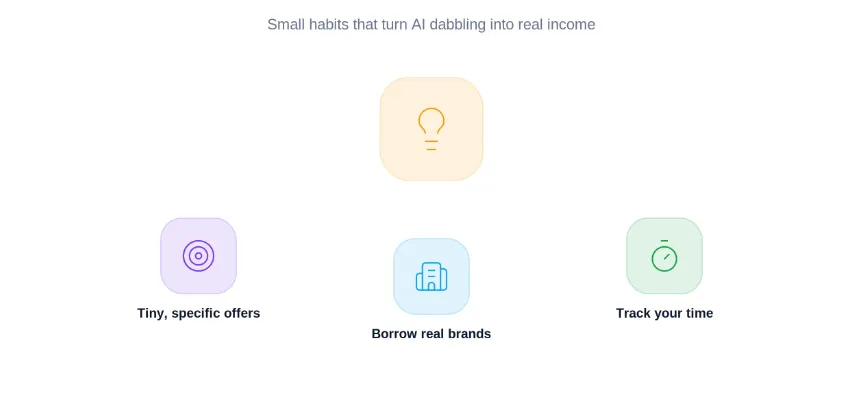
Instead of inventing fake brands, pick real small businesses whose content you can observe: a local café, a gym, or a campus group. Use AI to create sample posts, email drafts, or designs for them (even if you never send them). This practice forces your AI prompts to fit real-world constraints, which makes your portfolio much more convincing than generic examples.
Tip 3: Use AI to speed up your learning, not skip it.
You can ask AI tools to explain concepts, draft tutorials, or break down side hustle case studies into step‑by‑step plans. For example, paste a guide about print‑on‑demand into an AI summarizer and ask it to turn the key steps into a checklist that you follow this week. You stay in control, but the tool makes the “studying” part faster and less overwhelming.
Tip 4: Create tiny “offers” instead of vague services.
Instead of “I help with content,” offer something like “I’ll write one 800‑word blog post + 5 social captions for $X” or “I’ll design 5 simple T‑shirt graphics around your theme.” Specific offers are easier for buyers to say yes to, and easier for you to deliver consistently with AI’s help.
Tip 5: Track time for your first 10 projects.
Most people guess how long tasks take and misprice everything. If you actually measure how long it takes to create one article, one batch of posts, or one digital product, you can see how AI changes that over time. This helps you avoid undercharging and shows you clearly when your workflow is improving.
Tip 6: Surprise tip use “boring” admin skills as your entry ticket.
Many of the most successful AI beginners in 2025 and 2026 are not designers or writers; they’re regular workers or students who use AI to help with scheduling, inbox sorting, and data entry. Offer to be a virtual assistant who uses AI to handle routine tasks faster. Businesses get a mix of human reliability and AI speed, and you get steady income while you learn flashier skills on the side.
Tip 7: Bundle AI tools into “I’ll take it off your plate” promises.
People don’t want to learn 5 tools; they want outcomes like “your next 30 social posts are scheduled” or “your product descriptions are done by Friday.” When you bundle AI writing, design, and scheduling tools into one simple package, your lack of deep tech skills doesn’t matter — you’re selling relief, not software.
Tip 8: Write your own “no tech skills AI resume” as you go.
Every time you complete a project or build a product, write a 2-3 sentence note about what you did and what you used. After a few months, these stack into a strong story for internships, remote jobs, or higher‑paying clients: you can show that you’re not “technical,” but you are very good at operating AI tools in practical ways.
Advanced Insights What Nobody Else Tells You
Insight 1: Your lack of tech skills is secretly an advantage for mainstream clients.
Non-technical business owners often feel intimidated by “AI experts” who talk like engineers. When you come in as a normal person who explains things in plain language and focuses on simple outcomes, you feel safer to them. In practice, they care more about whether you can deliver clear results than whether you understand the model architecture behind the tool.
Insight 2: The biggest risk is platform dependence, not tool dependence.
Most people worry about “what if this AI tool shuts down,” but the more immediate risk is building your entire income on one platform: a single YouTube channel, an Etsy shop, or one freelancing site. Algorithms and rules change. That’s why it’s smarter to combine at least two channels over time — for example, client work plus digital products, or Etsy plus your own mailing list — so one change doesn’t wipe you out.
Insight 3: Repetition beats creativity in the first 90 days.
You might think you need a brand-new, clever idea to stand out, but most successful beginners in AI side hustles are repeating a very simple offer again and again, just for different people or niches. The repetition is what makes your prompts sharper, your editing faster, and your results stronger — and clients notice that long before they care about whether your brand name is unique.
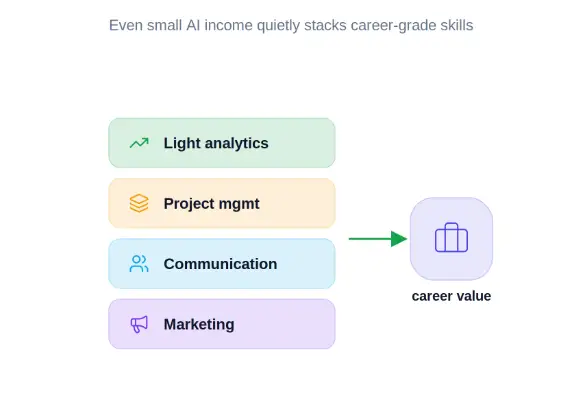
Insight 4: The real long‑term value is skill stacking, not just cash.
As you run even a small AI‑powered side hustle, you quietly learn project management, basic marketing, communication, and light analytics. Those are the exact skills a lot of employers in tech, marketing, and operations want, even if the role itself isn’t “AI‑related.” So even if your side hustle only ever brings in a few hundred dollars, the experience can push your career in a direction that pays far more later.
Frequently Asked Questions No Tech Skills Edition
Pick one beginner‑friendly path like AI‑assisted content writing, social media support, or print‑on‑demand designs, then learn one main AI tool that fits that path. Create a few sample pieces to prove you can guide the tool, even if they are for imaginary brands. After that, package your work into a simple offer and post it on one platform where buyers already are, such as a freelance marketplace or Etsy.
Some of the easiest options are AI‑assisted writing (blogs, emails, social captions), social media content support, AI‑generated designs for print‑on‑demand products, digital planners or prompt packs, and basic research or data tasks aided by AI. These rely on simple prompts and editing instead of any programming. Start with the one that matches whether you like words, visuals, or organizing information.
Yes, as long as you’re willing to practice operating the tools and communicating with clients or buyers. Many beginner‑focused guides and case studies show people with no tech background earning meaningful side income from AI‑assisted services and products. You won’t become rich overnight, but earning $100–$500/month over time is realistic for people who show up consistently and refine one path.
Earnings vary widely. Articles on AI side hustles describe beginners earning as little as small pocket money and as much as several hundred dollars per month once they have clients or products in place, with a smaller group reaching $1,000+ as they scale. Broader side hustle stats in the US suggest that a realistic early target is around $200/month, with higher amounts coming as you gain experience and build systems.
If you focus on a service like writing or social content and do daily outreach, you might land your first small paid project within 2–8 weeks. Product‑based paths like digital downloads, print‑on‑demand, or YouTube channels usually take longer — often 3–6 months — because they depend on search, algorithms, or building an audience. The key is committing to one path for at least 30 days before you judge it.
You don’t have to show every tool you use, but being honest about your process usually helps. Many guides recommend framing AI as the way you deliver faster, more consistent results while still editing everything yourself. For example, you can say, “I use AI tools to speed up drafts and research, then personally refine and fact-check every piece.” That builds trust and sets the right expectation.
Choose one writing‑focused AI tool (like ChatGPT‑style tools), one design tool with AI features (such as Canva’s AI options), and optionally a simple platform to sell or showcase your work (Etsy, Gumroad, or a freelance site). Learn each tool by following its built-in tutorials and replicating easy examples from beginner guides. Once you can comfortably produce one kind of output — a blog post, a design, a digital product — you’re ready to start testing offers.
Using AI to help with content, designs, or admin tasks is generally allowed as long as you respect copyright, platform rules, and each tool’s terms of service. As a student, you should separate paid work from school assignments and avoid using AI in ways that break academic integrity rules. Anything mentioned here is guidance based on public examples, not legal or financial advice, so always read the policies of the platforms and tools you use.
Start by listing the kinds of people or businesses you understand best — maybe local shops, creators you follow, or industries connected to your studies. Then browse guides that show how non-technical people help those niches with AI-assisted content, designs, or simple automations. Use AI to help brainstorm offer ideas, but choose one concrete outcome (like “10 social posts per week” or “5 designs per batch”) and test it with real messages and listings instead of staying stuck in planning mode.
Quick Summary Take This Away
If you skipped straight here, here’s the core: you don’t need coding or a tech degree to start making money with AI in 2026, but you do need one clear, no‑code path and a simple process. The most beginner‑friendly options are AI‑assisted content and social posts, AI‑generated designs for print‑on‑demand, faceless YouTube channels powered by AI scripts and visuals, AI‑helped digital products, and simple research or admin tasks that AI speeds up.
You start by choosing the lane that matches your natural strengths, learning one or two tools deeply, and building 2–3 sample projects to prove you can guide AI into something useful. Then you package your work into small, specific offers and put them in front of buyers on one platform for at least 30 days, adjusting based on what gets responses. Over time, you can combine steady service income with slower‑burn digital products or channels so that some of your work keeps paying you long after you create it.
If you remember nothing else, remember this: pick one no‑coding AI path, commit to it for 30–60 focused days, and let real‑world feedback shape your next moves instead of chasing every new AI trick. Your next step is to choose whether you’ll start with writing, visuals, or simple admin tasks, and plan your first three sample projects for this week.
Conclusion
Making money with AI as a non-technical person is less about hardware and algorithms and more about clear offers, basic tools, and consistent small actions. You don’t need to become an engineer to benefit; you just need to become good at operating the right tools to solve simple problems for real people.
The three big ideas are straightforward: start with a no‑code path that fits your strengths, use AI to speed up and improve your work instead of replacing your judgment, and commit to daily steps that put your offers in front of buyers. Over months, this mix builds both side income and a set of practical skills that will help you in almost any future job.
If you’re willing to be a beginner, test one offer, and keep going when things are quiet at the start, you’re already ahead of most people who only scroll and dream. Pick your lane today, block out time this week, and start building your first AI-assisted project — you’re more capable than you think.

[…] AI could add up to around $15.7 trillion to the global economy by 2030, which is already reshaping freelance work and online income in 2026. For students, that means two things: some entry-level tasks are […]